

The characteristics of a tennis racket: weight, balance, swingweight and twistweight
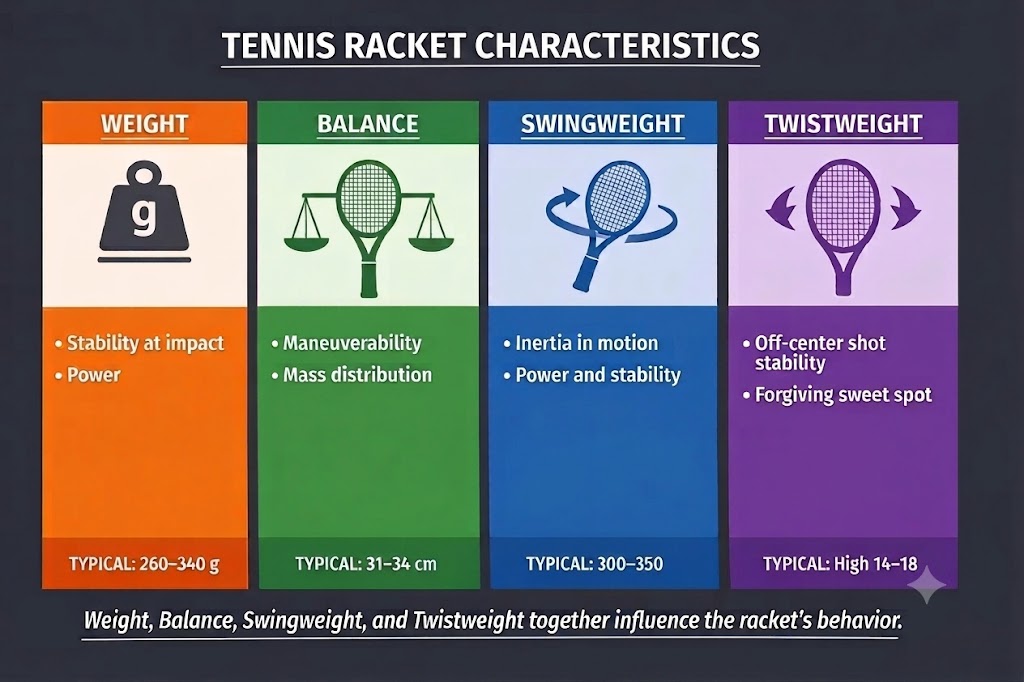
When choosing a tennis racket, people often look only at the weight. In reality, the behaviour of a frame depends on several parameters working together.
The four fundamental characteristics that determine how a racquet swings and reacts to ball impact are:
- weight
- balancing
- swingweight (inertia)
- Twistweight
Understanding these specifications allows you to understand why two seemingly similar racquets can offer completely different feel and performance.
The weight of the racket
Static weight indicates the total mass of the racket and is expressed in grams.
There are generally three categories in the current market:
| Racket weight | Frame type |
| 260-285 g | Lightweight and very manoeuvrable rackets |
| 290-305 g | Intermediate rackets for club players |
| 310-340 g | Competitive racquets |
A heavier racket tends to offer:
- greater stability on impact
- a fuller blow feeling
- best energy transfer to the ball
However, weight alone is not sufficient to describe the behaviour of a frame. Two rackets with the same weight can play very differently, because what really matters is how the weight is distributed along the frame.
The balance of the racket
The balance indicates the position of the racket's centre of gravity along its length.
For a standard 27-inch (68.5 cm) racket, typical values are:
| Balancing | Features |
| 31-32 cm | Head light (back balance) |
| 32-33 cm | Neutral balancing |
| 33-34 cm | Head heavy (advanced balancing) |
The balance primarily affects the racquet's handling.
Head light racket
- faster to move
- greater control
- ideal for net play and advance shots
Head heavy racket
- increased power
- greater stability
- heavier ball
Again, balance is only an indicator of weight distribution and does not fully describe the dynamic behaviour of the chassis.
Swingweight: the inertia of the racket
The swingweight is probably the most important specification for understanding how a racket performs on court.
The swingweight measures the racket's resistance to rotation during the swing, i.e. how heavy the racket feels when it's being moved.
In other words, it is the measure of the racket's inertia during movement.
Typical swingweight values (strung racquet)
| Swingweight | Sensation |
| 300–315 | Very manoeuvrable |
| 315–325 | Balance between manoeuvrability and stability |
| 325–335 | Competitive racquets |
| 335+ | Very stable but more challenging |
A high swingweight implies:
- greater stability on impact
- heavier ball
- greater ability to cross the ball (plow-through)
A lower swingweight, on the other hand, makes the racquet:
- Quicker in the swing
- less tiring to move
- more manoeuvrable in recoveries
Many club players find the sweet spot between 315 and 325 swingweight points.
The professionals' racquets
Obviously, there is no official data on the physical characteristics of the rackets used by top players; the ones we often see them use only have the paint job of the latest model they are endorsing and are radically different from what us mere mortals can buy in a shop.
On the website https://impactingtennis.com/pro_tour/pro-player-specs/ An up-to-date database from 2020 is available, with data sourced from industry forums, measurements taken by technicians or collectors, and disseminated online.
Some data from the database:
| Player | Weight (grams) | Balance (cm) | Swingweight (kg·cm²) |
| Roger Federer | 366.0 | 31.6 | 344 |
| Rafa Nadal | 343.0 | 33.7 | 367 |
| Novak Djokovic | 357.0 | 32.5 | 364 |
| Stan Wawrinka | 375.0 | 32.3 | 360 |
| Juan Martín del Potro | 367.0 | 31.4 | 355 |
Twistweight: stability on off-centre hits
The twistweight measures the racket's resistance to rotation around its longitudinal axis.
This parameter comes into play when the ball is hit off the centre of the sweet spot.
When the impact is off-centre, the racquet tends to rotate sideways. Rackets with higher twistweight resist this rotation better and maintain more stability.
The advantages are:
- less loss of power on off-centre hits
- greater control
- A more forgiving sweet spot
The swingweight depends mainly on the amount of weight distributed to the sides of the racquet's oval.
How these characteristics affect the game
Weight, balance, swingweight and twistweight are not independent parameters. Any change to one of these values inevitably changes the others.
For example, adding weight to the head of the racket (12 o'clock):
- maximum increase in swingweight
- leave the twistweight unchanged
- Move the balance forward
- greater power in shots
- more effort to accelerate the racket head
Instead, add weight to the sides of the racket head (3-9 o'clock):
- modest increase in swingweight
- maximum increase in twistweight
- Move the balance forward
- greater torsional stability
- more effort to spin the ball
For this reason, the design or customisation of a racket always involves finding the right balance between power, stability and manoeuvrability.
There is no perfect configuration for everyone: the ideal racket is the one that allows the player to express his technical gesture with maximum efficiency and minimum effort.


